
John George Sowerby - Children's Books and the Aesthetic Movement
John George Sowerby was born in 1850. He joined the Sowerby company at the age of 21 with the expectation that as the oldest son he would some day become the owner of the company.
As well as working at the Sowerby company John George Sowerby was also a gifted artist and illustrator. As an artist he produced oil and watercolour paintings which were displayed in many exhibitions including, for a number of years, the Royal Academy in London.
JG Sowerby was probably responsible for many of the glass designs produced by Sowerby's in the late 1870's and early 1880's. He also collaborated with other artists to produce a number of children's books the sum of which are outlined below.
In 1872 he married Amy Margaret Hewison and they subsequently had one son and five daughters:
John Lawrence b.1873, Margaret Helen b.1874, Katherine Githa b. 1876, Amy Millicent b. 1877, Marjory Gladys b.1879 and Rachel Ruth b.1882. (The names in bold are the names by which the children are more commonly known)
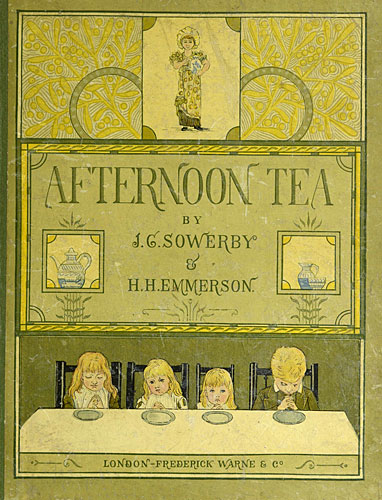
Sowerby probably used his children in the illustrations and stories in the books. The front cover of Afternoon Tea which was published in 1880 shows four children sitting at a table, the children may be Helen, Githa, Millicent and Lawrence who would have been six, four, three and seven at the time. The poem on page 22, 'The Bird-Catcher' and the accompanying picture, names the three oldest children, Lawrence, Helen and Gisha (sic). The same children are seen in other pictures in this book, and other books, with their names changed to reflect the stories.
J G Sowerby - Children's Books
Mouse over for more information, click to open PDF file in new window.

J G Sowerby Books - Notes
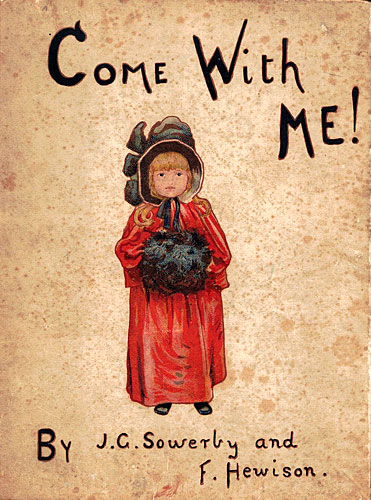
Come With Me! - 1879? A small 34 page book illustrated by JG Sowerby with verses by Frederick Hewison who was JG Sowerby's brother-in-law. The book was printed and published by R.Robinson & Company of Newcastle upon Tyne who also printed the Sowerby company's pattern books in 1882 and 1885. This book was probably self published by JG Sowerby as his first book.
Afternoon Tea - 1880 An illustrated collection of poems by JG Sowerby in collaboration with Henry Hetherington Emmerson, English painter and illustrator. The book was published by Frederick Warne & Co in London. The book was also published in America. Moving to a larger publisher allowed the book to be published overseas.
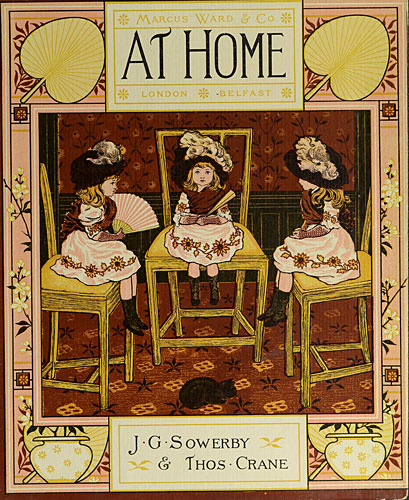
At Home - 1881 With coloured illustrations by JG Sowerby, colour-printed borders and decorative elements by Thomas Crane and verses by Eliza Keary. Thomas Crane (1843–1903) was the older brother of Walter Crane (1845–1915) the famous English illustrator designer, and painter. Thomas was a noted designer of decorative greeting cards and illustrator of children's books. He was the director of design at Marcus Ward and Co. in London who published At Home.
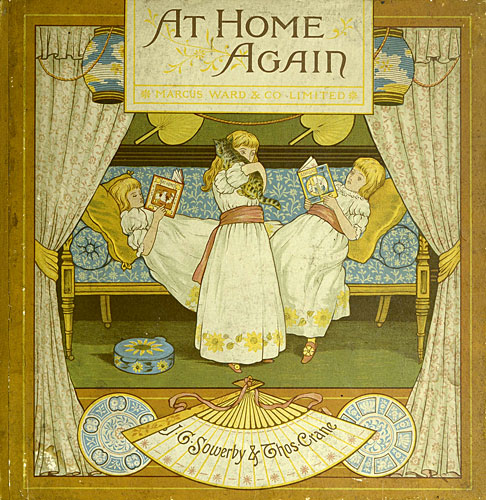
At Home Again - 1886 The front cover of At Home Again, shows two girls reading At Home and Abroad. JG Sowerby is back with Thomas Crane and Eliza Keary.
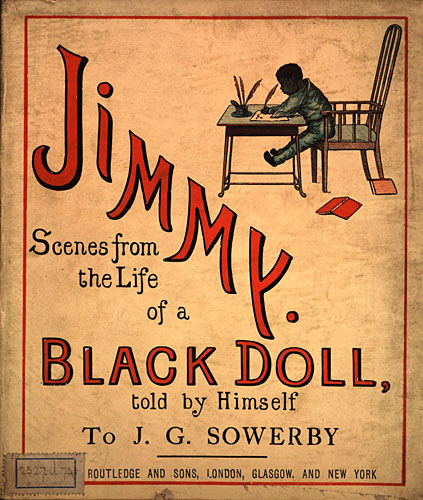
Jimmy,Scenes from the life of a Black Doll. as told by himself - 1888
Published by George Routledge, engraved and printed by Edmund Evans. Assuming this is based on a 'true' story, black dolls were rare in Victorian England, this one may have been a black painted bisque doll possibly made in Germany.
On page 15, after being dropped in a brook, Jimmy relates: "Some of my skin came off with the cold and lying so long in the water I suppose ; and when I was taken out of the water I found I was quite white underneath".
Illustrated and written by J.G. Sowerby, the novelty of a black doll may have been the inspiration for writing this story. The book is about Jimmy, a black doll who embarks on a series of adventures.
It tells of his, and his fellow doll's ill treatment at the hands of his owner and concludes with an admonishment to children to treat their dolls more kindly.
Jimmy is also seen being bathed on page 45 of "At Home Again"
.
George Routledge & Sons partnered with Walter Crane to produce "Toy Books", designs from some of these books feature on Sowerby's nursery rhyme glass.
Like "Come With Me!", J.G Sowerby seems to have self published this book.
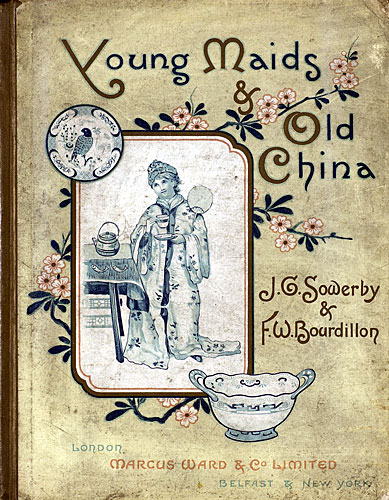
Young Maids and Old China - 1889
Illustrated by J.G. Sowerby, with poems written by F.W. Bourdillon and published by Marcus Ward & Co. London. With detailed illustrations often featuring blue/white decoration, reflecting the aesthetic movement popular at the time.
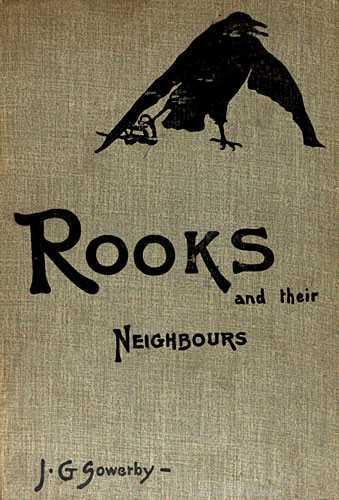
Rooks and their Neighbours - 1895
Written and illustrated in black and white by J. G. Sowerby, published in 1895 by Gay & Bird (London), Mawson, Swan & Morgan (Newcastle-on-Tyne).
Not written especially for children, the book's Preface states:
This book lays no claim to be considered a scientific treatise. The text is an enlargement of notes on the subject made by the author,
and the sketches illustrating them have been drawn by him from time to time. Neither can it be called a book of popular natural history;
it is merely some desultory gossip about "ROOKS AND THEIR NEIGHBOURS".
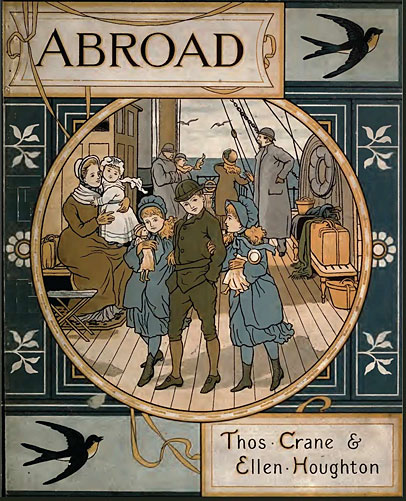
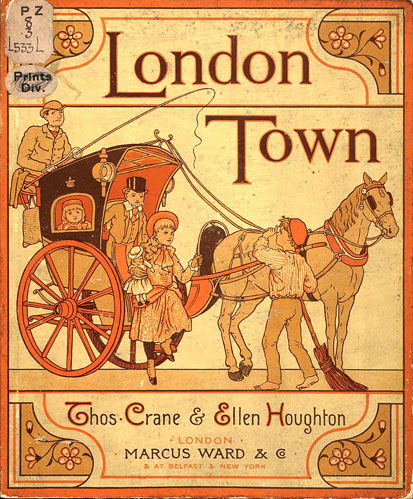
Abroad (1882) and London Town(1883)
These two books are not by JG Sowerby but are part of the same series. The back covers of the books describe them both as "Companion Volume to AT HOME Uniform in size and price". In date they fall between At Home and At Home Again.
Both are written and illustrated by Thomas Crane and his cousin Ellen Houghton. Abroad recalls a trip across the English Channel and a holiday in France, while London Town shows the sights of London through poetry and illustrations.
JG Sowerby was having problems at the Sowerby glassworks which lead to his removal as chairman of the company in November 1883. The loss of income resulted in his bankruptcy which may be the reason why he did not colloborate with Thomas Crane on Abroad and London Town.
JG Sowerby was back with Crane in 1886 with At Home Again
John George Sowerby - Children's Books and the Aesthetic Movement
Between 1879 and 1889, when the books listed above were written, John George Sowerby and his family lived in two large houses in Gateshead,
Ravenshill in Low Fell (c.1877-1883) and Field House, High Teams (c.1886-1889). Both houses are now long gone but just as with his children it seems lightly that JG Sowerby used his houses to depict scenes in his books.
"At Home" and "At Home Again" with illustrations by JG Sowerby and borders by Thomas Crane and "Young Maids and Old China" show many examples of the Anglo-Japanese taste of the Aesthetic Movement.
Chinese and Japanese ceramics, Japanese fans, lanterns. peacock feathers, sunflowers, furniture, Venetian glass, William Morris style wallpapers and the yellow, green and blue colours are all associated with that period.
It shows that JG Sowerby was fully signed up to the "Art for Art's Sake" philosophy, there may even be some of his paintings on the walls in some of the pictures but, ironically, there does not seem to be any Sowerby glass.